26 September 2026
Today is Childhood Brain Cancer Awareness Day. Brain cancer is the leading cause of cancer death in children. For children diagnosed with DIPG, a devastating tumour that forms deep in the brainstem, there is still no cure.
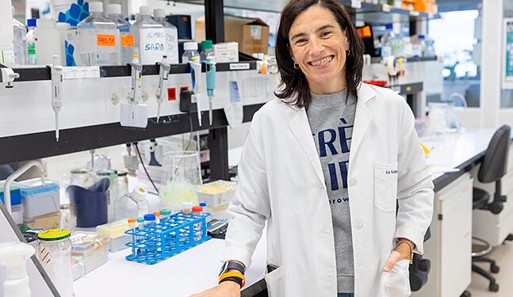
Researchers like A/Prof Marta Alonso are working to change that. Today, we’re shining a light on Marta and her relentless pursuit of better treatments, and ultimately, a cure, for children with DIPG.
Diffuse midline glioma, or DMG, is a group of aggressive brain tumours that arise in the deep, central structures of the brain. The most common form in children, known as Diffuse Instrinsic Pontine Glioma (DIPG), develops in the brainstem. This location contains vital structures controlling breathing, movement, and consciousness, which makes treatment extraordinarily difficult and highly risky. For families facing a DMG diagnosis, the reality is devastating. Almost no child survives. Despite decades of dedicated clinical trials, radiotherapy remains the only standard treatment available today. However, radiation is not a cure; it offers only temporary relief by shrinking the tumour and easing neurological symptoms. Beating DMG will require science that thinks differently.
Associate Professor Marta Alonso is not someone who accepts the status quo. Based at the University of Navarra in Pamplona, Spain, she led the world’s first clinical trial of a cancer-killing virus in children with DIPG, publishing her results in the New England Journal of Medicine in 2022. That trial showed, for the first time, that a virus could be safely delivered into a child’s brainstem, and was associated with survival that compared favourably with historical outcomes for this disease.
But Marta and her lab did not stop there. She wanted to build something better.

Alegra’s Army Grant
With support from a $200,000 AUD Alegra’s Army Grant from the Charlie Teo Foundation in partnership with the Little Legs Foundation, Marta spent two years developing a new generation of that virus, called Delta-24-TIMker-ACT.
This project directly addresses two of CTF’s core research strategy themes: blood-brain barrier and delivery, and tumour immune microenvironment. These are two of the most fundamental barriers standing between current science and better outcomes for children with brain cancer.
Two of the biggest obstacles in treating DIPG are getting a therapy to the tumour in the first place, and then getting the immune system to actually fight it. Most drugs cannot cross the blood-brain barrier to reach the tumour at effective levels. And even when a therapy does reach a DIPG tumour, it faces a microenvironment that is actively hostile to the immune system, one that exhausts and suppresses the body’s own cancer-fighting cells, essentially turning off the immune response before it can do its job.
Marta’s new virus tackles both problems at once. Rather than trying to get a therapy across the blood-brain barrier, a challenge that has defeated countless treatments, Marta’s approach sidesteps the problem entirely. The virus is injected directly into the tumour through a stereotactic needle, the same technique used to take the biopsy, delivering it right where it needs to be. Once inside, the virus is engineered to do two things. First, it stimulates the immune system’s own cancer-fighting cells, called T cells, to multiply and attack. Second, it releases a specially designed antibody that blocks TIM-3, the molecule DMG tumours use to exhaust and silence those same immune cells. Together, these two mechanisms work in tandem: one wakes the immune system up, the other clears the barrier that was stopping it from doing its job.
“This project helped us develop a new generation of oncolytic viruses designed specifically for children with DIPG and other aggressive brain tumours. We have shown that these viruses can not only attack tumour cells directly but also help the immune system recognise and fight the cancer.
Every step forward brings us closer to developing new treatment options for children facing diseases that currently have very few effective therapies.”
A/Prof Marta Alonso, University of Navarra, Spain
Developing the right human antibody to block TIM-3 was itself a major undertaking. The team screened sixteen candidates before identifying the two most promising. These were then validated in orthotopic animal models of DIPG, where tumour cells are implanted directly into the brainstem to closely replicate the human disease. The new virus, armed with both components, was built and tested in these same models, where it demonstrated significantly improved survival compared to the previous generation virus, extending median survival from approximately 48 days to over 62 days. Importantly, the results also showed meaningful remodelling of the tumour immune microenvironment, consistent with the virus doing exactly what it was designed to do: not just killing tumour cells directly, but reprogramming the immune landscape of the tumour from within. Two international patents have been filed to protect the technology. Work is now underway to produce the human version of the virus, with the goal of completing the studies needed to bring this therapy into clinical trials for children with DIPG.
“The support from the Charlie Teo Foundation and the Little Legs Foundation allowed us to generate critical data that would not have been possible otherwise. It helped us validate key aspects of our new therapeutic approach and provided the foundation for larger international collaborations and follow-on funding. Most importantly, it has enabled us to continue advancing this work towards clinical translation, bringing us closer to testing these therapies in children.”
A/Prof Marta Alonso, University of Navarra, Spain

What comes next?
The team is now manufacturing a clinical-grade version of the virus and completing the regulatory studies required to launch a first-in-child clinical trial in children with DIPG.
“We are now focused on taking these discoveries from the laboratory to the clinic. We are working to manufacture a clinical-grade virus and complete the studies required by regulatory agencies so we can launch future clinical trials for children with DIPG. Although there is still work ahead, we believe this programme has the potential to offer new hope to families affected by this devastating disease.”
A/Prof Marta Alonso, University of Navarra, Spain