
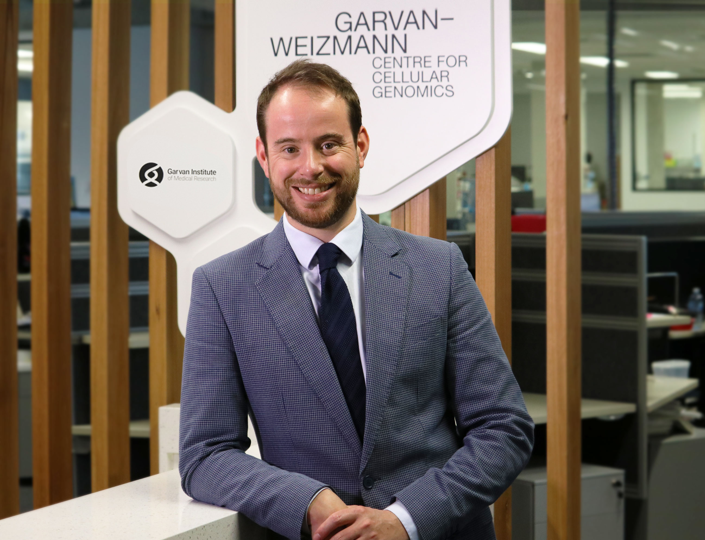
Prof Joseph Powell is a biomedical researcher and geneticist at the Garvan Institute of Medical Research, Australia. Prof Powell completed his PhD at Edinburgh University in 2010 and is now the Director of the Garvan-Weizmann Centre for Cellular Genomics. Prof Powell is a leader in his field, publishing in world-leading journals and having received numerous awards including the NHMRC Research Excellence Medal. He was also the youngest ever recipient of the Commonwealth Health Minister’s Medal and received the Ruth Stephens Gani Medal, an Australian award for outstanding achievement in human genetics.
Meet the Researcher
Why is this project game-changing?
This project will generate a large source of genomics data on brain cancers, a crucial step in understanding the genomic variability of brain cancer. Further, Prof Powell will leverage expertise from machine-learning, biology, genetics and advanced biotechnology domains in an effort to unravel the deep complexities of brain cancer and find effective treatment strategies for brain cancer patients.
How can it potentially help people with brain cancer?
Brain cancer is one of the most lethal cancers, with few effective treatments available for patients. Moreover, a hallmark of brain tumours is its ability to resist treatment due to its complex and variable genetic make-up. By understanding this genetic complexity, Prof Powell’s research team aims to find the ‘bad actors’ responsible for brain cancers resisting treatment and find effective treatments.
Scientific Description
Identifying therapeutic targets from cell state models in gliomas
Glioblastoma is one of the deadliest human cancers, due to its strong resistance to treatment following surgical removal. This resistance is driven by an intrinsic intra-tumoral heterogeneity, which is a hallmark of these tumours. To develop new treatments to overcome this cellular heterogeneity, a more detailed understanding of the nature and drivers of this variation is needed. Single-cell RNA sequencing of human tumours provides a powerful means to systematically interrogate the diversity of malignant and normal cell states.
Recent studies, as well as Prof Powell's work, have highlighted transcriptional cell state diversity across tumour types that is often independent of genetic clonal heterogeneity. His team has developed highly accurate machine learning methods that are able to use the transcriptional signature of a single cell and are able to accurately classify it into a specific cell state. The researchers are able to ‘map’ the within-tumour heterogeneity from thousands of cells in a single patient sample. Doing so over a large clinical cohort across different subtypes of adult diffuse gliomas including astrocytomas, oligodendrogliomas and glioblastomas will allow them to identity the variation in the within-tumour heterogeneity between patients and correlate those cell states with clinical features, recurrence, and treatment resistance. The relationship between cell states and state dynamics will be tested against disease history and clinical features for each cancer classification type (following WHO CNS5 framework).
This project builds on Prof Powell's current research which has been supported by the Charlie Teo Foundation. His team will extend their research into the identification of the genomic drivers of cell states and state dynamics that correlate with clinical outcomes, generating new data on targeted glioblastoma patient cohort, and developing the high-throughput cancer organoid systems to be able to perform high-throughput drug screening against specific tumour cell states.
• HOPE • COMMUNITY • OPENNESS •