
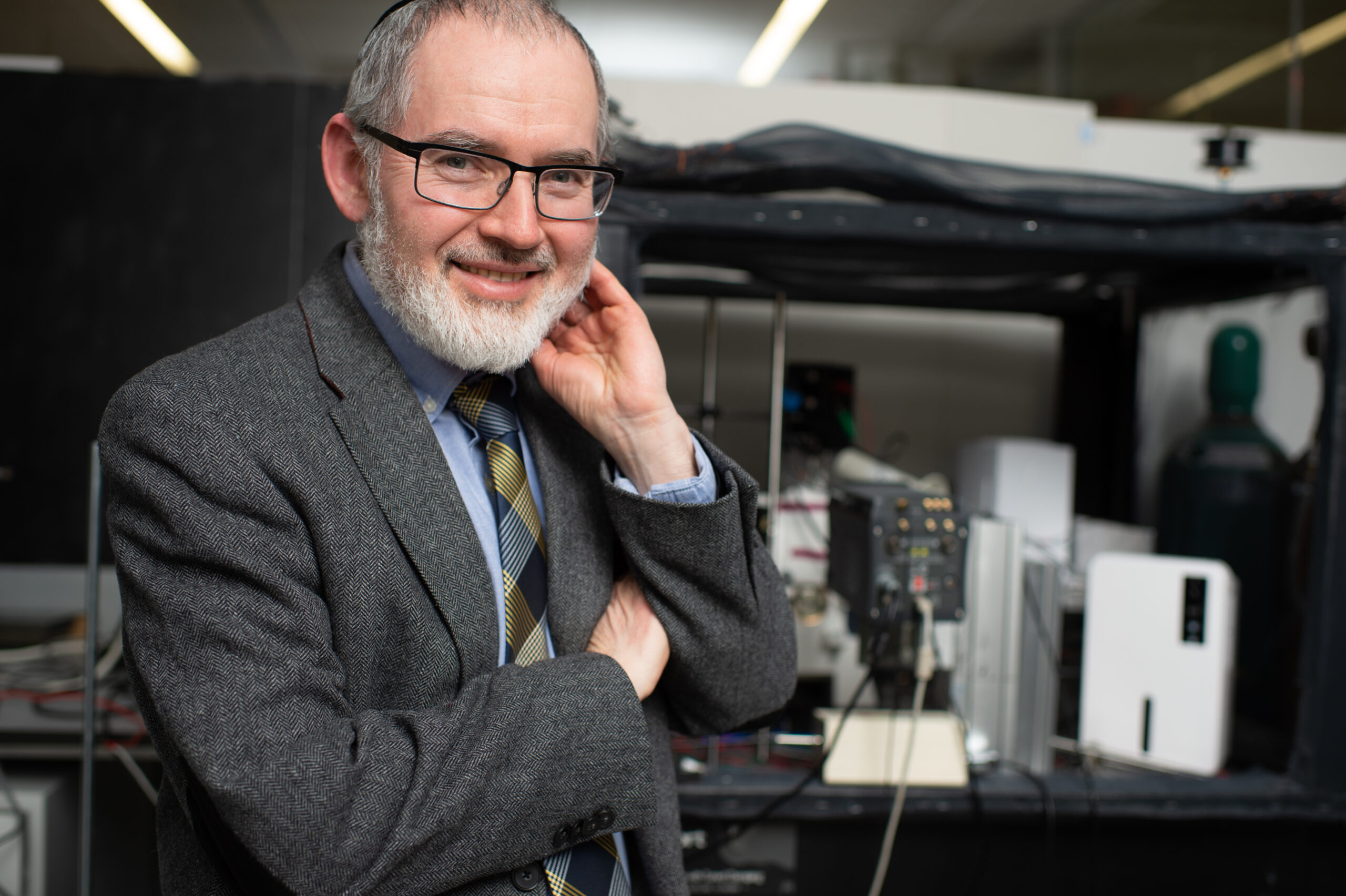
Prof Michael Keidar is an A. James Clark Professor of Engineering at George Washington University, Washington D.C, USA. Prof Keidar completed his PhD at Tel Aviv University in Israel, has several senior academic positions in the United States and is the director of the Micro-propulsion and Nanotechnology Laboratory. He has over 25 years of experience with a research focus in plasma-based nanotechnology, cold plasma physics and applications in biotechnology.
Meet the Researcher
Why is this project game-changing?
The technology in the project, called plasma discharge tube (PDT) technology, emits electromagnetic waves and can disrupt brain cancer cell growth and spread in a non-invasive manner. Studies at the George Washington University indicate that the PDT device renders brain tumours more sensitive to chemotherapy drugs such as standard of care drug therapy temozolomide. This will be the first treatment to utilise high frequency electromagnetic waves to improve the effectiveness of brain cancer therapy while selectively targeting cancer cells and leaving normal brain tissue unharmed.
How can it potentially help people with brain cancer?
This technology will provide a new and non-invasive approach to treating brain cancer patients. The treatment generates electromagnetic fields that can penetrate the scalp and effectively disrupt GBM cells from growing and spreading. To do this, the electromagnetic wave-emitting device is positioned on top of the scalp and targets the precise location of the brain tumour making the cancer cells more susceptible to standard brain cancer drug therapy temozolomide.
Scientific description
Cold plasma discharge tube for glioblastoma treatment
The standard of care for newly diagnosed GBM is maximal surgical resection followed by concurrent radiation and chemotherapy then adjuvant chemotherapy (i.e., temozolomide (TMZ)), which has been shown to only improve median survival ranging from 12-22 months and a dismal five-year survival rate of less than 10%. To date, no effective method exists to eradicate malignant glioblastoma. Researching the literature on available cancer therapies led to the following conclusions: (a) there is a need for non-invasive cancer treatment therapies that selectively induce cancer cell death without harming normal cells; (b) current comparable treatments, including tumour-treating fields (TTFs), require long treatment times from 18-22 hours per day, consistent head shaving, and are reported to cause > 10% skin irritation and sleep disturbances. To overcome these drawbacks, this team proposes a new treatment approach based on its proprietary Plasma Discharge Tube (PDT) Technology that is designed for non-invasive treatment of glioblastoma (GBM) in combination with chemotherapy. Cold Atmospheric Plasma (CAP), utilized for the development of the PDT device, has consistently exhibited a positive anticancer activity as a stand-alone therapy that can provide genotoxic and phototoxic effects. An ongoing study at GWU suggests that electromagnetic waves formed by CAP can be coupled with cells and might lead to cancer cell sensitization. Unlike drugs, the effect of the PDT delivery system is not diffusion-dependent because the CAP jet can be positioned to treat specific regions in a tumour.
• HOPE • COMMUNITY • OPENNESS •